The Burying of the Hatchet
by Joan Green Wycoff
The day dawned with a red streak in the east, not unusual for a typical Southwest Oklahoma August but prophetic for the townspeople of a little community nestled there. Everyone went about their usual chores on that early morning, but there seemed to be a sigh of relief in the slight breeze rustling through the trees. The feud was over. Not the killing feud of the Hatfields and McCoys, thank goodness, but still a feud that simmered for five long years with the embers of animosity, distrust, anger, hard-feelings, and even hatred. West Duke versus East Duke; Old Town versus New Town. Thoughts were turned to how it all began…
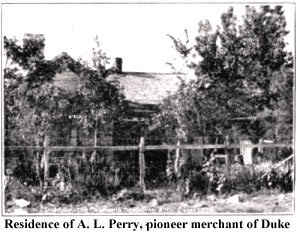
In 1887, when an abundance of wild turkeys, prairie chickens, deer and horned toads roamed these parts, A.L. Perry, his wife Alice, and Chancey Phelps, Mr. Perry’s brother-in-law, established a general store in the area near the beautiful Turkey Creek Valley, or so it was advertised. Perry’s Mercantile, or “racket store” as they were called, was a place where you could buy a little bit of everything,” from toys to seeds, food to household goods and bonnets to plows. (Our very own Darby’s Big Furniture was bought from Mr. Perry in 1910 and started as Darby’s Mercantile Store.) Besides owning a very lucrative store, Mr. Perry dealt in real estate and was able to buy a lot of the land around him. When Alice asked him to name the developing town in her brother’s honor, he had the power and influence to see that it was done. So Duke was named after the Honorable F B Duke, County Judge, and territorial circuit judge who traveled throughout the area and headquartered in Mangum. In September of 1890, Duke was officially “put on the map” when Mr. Perry applied for and was granted a Post Office. He became its first Postmaster and held the job for 18 years. The Perry’s, wealthier than most, lived in the two-story house by the Methodist Church (behind us). Kids on the way home from school stopped to stare in wonder at the luxury of the goldfish pond built in front. There was one distinct advantage Mr. Perry’s New Town, or East Duke, had as compared to the Old Town, or West Duke, developing down the street …his land was on high ground!
Now Old Town was a settlement of foreigners also drawn to the water and living a little closer to Turkey Creek. In fact, it was one-fourth mile west of East Duke (in what is now the Fast Track area) and was dubbed West Duke almost immediately. It was home to Assyrians as well as people from Lebanon, Czechoslovakia, Germany and a few from England. A big problem was that West Duke was on low ground and, when it really rained as it can do, “ole Turkey” flooded (and did until they built the Turkey Creek Water Shed in 2004). Mr. Perry didn’t feel this healthful or safe and West Duke seemed to be the rougher side of town. A saloon in West Duke is remembered for a man getting shot in the neck and lying in the ditch all night without help. He lived, married, and lived to a ripe old age to tell the story with a neck that wouldn’t move. Of course, there was Shaker Kouri who had his own Mercantile Store in Old Town. Shaker, being a man of vision, had the foresight to build his store on stilts to avoid being flooded. During the feud, one of the favorite things for East Duke boys to do was to go under Shaker Kouri’s store and light firecrackers. Much to their glee, Shaker nearly had a heart attack as he thought he was being shot at!
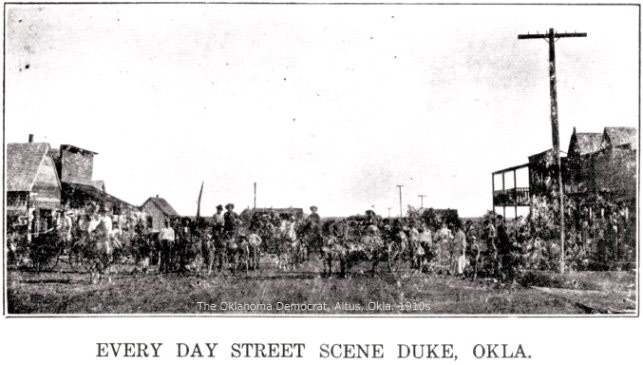
As years passed, the two Duke “communities” continued to grow. A gin, a grist mill, hotels, barber shops and even a bank was added. Newcomers were faced with the delima of whether to live in East Duke or West Duke. Animosity turned to verbal disagreements, verbal disagreements to fist fights, and fist fights to unproved but suspected violence. One hotel in West Duke was burned to the ground. Arson was suspected. The Altus, Wichita Falls, & Hollis Railway coming from Altus to El Paso and passing through the two communities of Duke caused even more contention. In fact, the rivalry was so intense that the railroad, completed in June 1910, had to build its depot in what was called “No Man’s Land,” or the area between East Duke and West Duke (across the street from where the Planter’s Co-Op Elevator is today).
Also, in 1910 there was a large fire in East Duke with many businesses burning – Holler and Render, Real Estate and Insurance; Darby Brothers, Hardware and Groceries; the Post Office in Darby’s Store; McKibbin’s Billard Hall; and McCauley’s Hotel to name a few. No arson was suspected but there wasn’t much that could be done with archaic fire equipment, sparse water and Oklahoma winds. Always on the lookout for East Duke, however, Mr. Perry and his supporters provided temporary quarters for these businesses until new ones could be built. (The Duke fire of 1976 that many of us witnessed could have been déjà vu.)
Another contention that added verbal “fire” to the feud was a new school bond election. Each”Duke” had its own school, although they were only 400 years apart, and, of course, each Duke wanted the new school located in their side. There was much heated debate. The first bond election failed. However, the second bond election ended with a vote for New Town. The “handwriting was written on the wall” by this time and a settlement of the five year feud was in the air, like a sigh of relief rustling through the trees that August day in 1912…
Out of respect people dressed in their Sunday-go-to-meeting clothes, or at least their cleanest. Men put on their hats and gathered up their women folk who had doned their newest bonnets for the occasion. Youngsters were gathered up in arms or held by the hand or happily trudged ahead. Everyone headed for the intersection in the middle of East Duke to see the “grave” that had been newly excavated. The town bands played and people shouted for joy when the horse-drawn *hearse approached. The harnesses rattled, the plumes on the horses’ bridles tittered back and forth, and the hand-made coffin could be seen from the glass windows as the slow-moving hearse approached. Inside the coffin rested a red painted “bloody” hatchet that symbolized all the division and animosity of these two communities. It was truly an Oklahoma “Tale of Two Cities” as Mr. Perry, representing East Duke, and Shaker Kouri, representing West Duke, met over the open coffin and shook hands to show the feud was finally ended. The ceremony was solemn with bystanders keeping their peace. All knew how great the effort had been to get these two men to shake hands. The coffin was closed, slowly lowered into the ground by ropes and covered with dirt.
As with any good tale, there is the “rest of the story”… The “peace treaty” enacted that day provided that New Town would provide a free lot to any citizen who wished to move “up” to East Duke. Soon, the site of Old Town, or West Duke, was deserted with only a large cement structure of the old water reservoir remaining as mute evidence that it ever existed (those walls south of Fast Track was taken down several years ago to provide more farm land). Eventually Shaker Kouri moved as did many of the Kouri’s, some settled in the Willow area north of Mangum and live there today. Assyrians like the Salaney’s and the Massad’s stayed. Machin’s from England stayed. Germans like the Heidenrich’s stayed. In fact, it is believed two young Heidenrich men were the actually surveyors of the original Duke town plot and that’s how they came to settle here. They were all an important part of our history and remain a part of our legacy today as many of their ancestors are present day citizens.
As we reenact this 100 year-old moment in the history of Duke, let us remember the pioneers who came to our great area to live and raise their families, let us remember the struggles they overcame as well as their triumphs that make us what we are today, and let us remember above all a community who came together with the best interests of its citizens and continues to do so to this very day. We who live here can all say we are proud to be citizens of what is officially East Duke but what we know and love as just plain Duke.
*wagon came down the road. Harness chains jingled, wagon wheels creaked, and horses’ hoofs kicked up dirt in the dry air as all eyes were riveted to the small box lying in back. Inside this makeshift coffin *

ADDITIONAL INFORMATION:
The question always comes up as to why Duke was dubbed “Snuff Town” or “Garrett City.” Along about the time of the feud (by 1917 the name was already well-known and commonly used) and the railroad’s arrival, people made their living for the most part by farming. Farmers driving teams of horses to plow couldn’t afford the luxury of stopping to light up a cigarette, so they settled for snuff. Women, too, were snuff users. This was a fine powdery snuff that came in glass jars that could be used later for the ladies’ dinner table or round cans that the working man could carry easily in the pocket of his overalls. Women, too, kept snuff cans for easy access in their apron pockets. One of the best ways to use snuff back in the old days was with a “snuffstick.” A twig off a limb or a bush was either beat with a hammer until soft and pliable or chewed. Then the homemade bristles could be chewed on till needed, A good dip in snuff, a good swirl all around the inside of the mouth, and tobacco pleasure was yours for a good long time. These “snuffsticks” were widely used by men and women of all ages. Legend has it that so much snuff was used in Duke that they brought it in by the boxcar load. A boxcar turning over and helpful Oklahoma breezes dusting the entire town in snuff, a part of the legend, ensured the name “Snuff Town.” “Garrett City” was one of the more popular and prestigious brands, and so it sounded more high class after a while to refer to “Snuff Town” as “Garrett City.”

 Duke, Oklahoma